
+- T0rrentinvites - #1 To Buy, Trade, Sell Or Find Free Tracker Invites! (https://t0rrentinvites.com)
+-- Forum: Other Discussions (https://t0rrentinvites.com/forumdisplay.php?fid=30)
+--- Forum: General PC Chat And Help (https://t0rrentinvites.com/forumdisplay.php?fid=33)
+--- Thread: AMD FSR 4.1.2 Now Runs On Intel Arc XMX Cores, Delivering Better Image Quality Than XeSS Upscaling With Similar Performa (/showthread.php?tid=21543)
AMD FSR 4.1.2 Now Runs On Intel Arc XMX Cores, Delivering Better Image Quality Than XeSS Upscaling With Similar Performa - Wolf - 10-24-2026
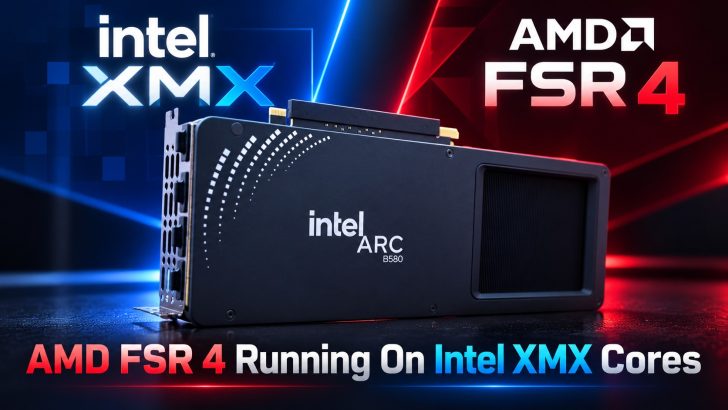
The modding community has achieved another impressive feat, this time bringing AMD's latest FSR 4.1.2 upscaling models to Intel Arc GPUs with hardware acceleration through their dedicated XMX cores. Better yet, early community testing suggests that the optimized implementation can deliver noticeably better image quality than Intel's own XeSS Super Resolution machine learning-based Temporal Anti-Aliasing and Upscaling (TAAU) solution, all while maintaining remarkably similar upscaling costs.
The breakthrough comes courtesy of the OptiScaler modding community, which has been experimenting with modified FSR 4 INT8 DLLs optimized for Intel's Xe Matrix Extensions (XMX) hardware. While AMD's FSR 4 upscaling models could already run on unsupported GPUs through OptiScaler, taking advantage of Intel's dedicated AI acceleration hardware makes the technology substantially more efficient than relying on conventional shader-based execution.
RELATED STORY ASUS Finally Builds An Intel Arc Graphics Card After Two Generations On The Sidelines, And It’s The Full 32 GB Big Battlemage Arc Pro B70

The timing is particularly interesting, as AMD recently expanded official FSR 4.1 support to older Radeon architectures and integrated graphics through its Adrenalin 26.10.1 driver. The newly available FSR 4.1.2 Lite model — an INT8 model which primarily targets mobile chips, handhelds, and APUs (such as specific Ryzen AI and Z-series/handheld platforms) rather than standard desktop RDNA 2 GPUs — is especially promising for less powerful GPUs, employing a smaller neural network to substantially reduce computational requirements while retaining much of the image quality associated with the full model.
According to community benchmarks posted on the r/Intel Arc subeddit, an Intel Arc B580 running Clair Obscur: Expedition 33 at 1080p with the Balanced upscaling preset demonstrates how efficiently its XMX cores can execute these modified FSR 4 models. Compared with the conventional DP4a execution path, the XMX-accelerated variants deliver substantially lower upscaling times, bringing the Lite model much closer to Intel's native XeSS SR implementation.
According to community benchmarks posted on the r/Intel Arc subeddit, an Intel Arc B580 running Clair Obscur: Expedition 33 at 1080p with the Balanced upscaling preset demonstrates how efficiently its XMX cores can execute these modified FSR 4 models. Compared with the conventional DP4a execution path, the XMX-accelerated variants deliver substantially lower upscaling times, bringing the Lite model much closer to Intel's native XeSS SR implementation.
Additional benchmarks shared by the OptiScaler community demonstrate just how efficiently Intel's XMX cores can handle AMD's FSR 4 models. On an Intel Arc A770 at 1080p using the Quality preset in The Witcher 3: Wild Hunt — Remastered, FSR 4.1.2 Lite actually delivered slightly higher performance than native XeSS SR, reaching 101.5 FPS versus 101.1 FPS, while also recording a lower upscaling time of 0.75 ms versus 0.84 ms. Even the full FSR 4.1.2 model performed respectably, with an upscaling cost of just 1.11 ms.
Upscaler Average FPS Upscaling Time
FSR 4.1.2 Lite XMX 101.5 0.75 ms
FSR 4.1.2 XMX 98.6 1.11 ms
FSR 4.0.2 XMX 98.0 1.17 ms
FSR 4.0.2 XMX (Modified) 97.2 1.18 ms
Intel XeSS SR XMX 101.1 0.84 ms
Upscaler Average FPS Upscaling Time
FSR 4.1.2 Lite XMX 101.5 0.75 ms
FSR 4.1.2 XMX 98.6 1.11 ms
FSR 4.0.2 XMX 98.0 1.17 ms
FSR 4.0.2 XMX (Modified) 97.2 1.18 ms
Intel XeSS SR XMX 101.1 0.84 ms


Meanwhile, an Intel Arc B580 owner benchmarked the different upscaling models in Clair Obscur: Expedition 33 at 1080p using the Balanced preset, with similarly impressive results. FSR 4.1.2 Lite required just 0.59 ms, practically matching XeSS SR at 0.58 ms, while the full FSR 4.1.2 model took only 0.85 ms. These results are particularly encouraging considering that community testers report substantially better image quality with AMD's neural upscaling models than with Intel's native XeSS SR implementation.
Upscaler Upscaling Time
FSR 4.1.2 Lite XMX ~0.59 ms
FSR 4.1.2 XMX ~0.85 ms
FSR 4.0.2 XMX ~0.87 ms
FSR 4.0.2 Fixed XMX ~0.88 ms
Intel XeSS SR XMX ~0.58 ms
Upscaler Upscaling Time
FSR 4.1.2 Lite XMX ~0.59 ms
FSR 4.1.2 XMX ~0.85 ms
FSR 4.0.2 XMX ~0.87 ms
FSR 4.0.2 Fixed XMX ~0.88 ms
Intel XeSS SR XMX ~0.58 ms


These community benchmarks suggest that FSR 4.1.2 Lite is an especially compelling alternative to XeSS Super Resolution for Intel Arc owners, potentially offering superior image reconstruction at virtually no additional performance cost. Naturally, the results will vary depending on the game, resolution, and upscaling preset.
What makes this development particularly exciting is the image quality advantage reported by testers. Multiple OptiScaler community members claim that FSR 4.1.2 produces a visibly superior image to Intel's latest XeSS Super Resolution implementation, even when XeSS SR runs natively on XMX hardware. The Lite model reportedly preserves much of that advantage despite its substantially reduced computational requirements, making it an appealing alternative for Intel Arc owners dissatisfied with XeSS SR's image reconstruction.
One user testing the mod across several games on an Intel-based handheld reported practically identical framerates between FSR 4.1.2 Lite and XeSS SR, but considerably better image quality with AMD's solution. Another Arc A770 owner demonstrated Assassin's Creed Odyssey running at 4K with FSR 4.1.2 XMX and Intel XeSS Frame Generation, reaching a reported 120 FPS with 4× frame generation enabled, although that figure includes generated frames rather than representing native rendering performance.
Of course, the implementation remains experimental. Compatibility varies between games, and users have reported crashes in certain titles, including Crimson Desert. The XMX-optimized FSR 4 implementation currently relies on a DirectX 12-based execution path, with support for other APIs remaining more limited. The claimed image quality improvements also deserve further controlled comparisons across different games, resolutions, and upscaling presets.
Nevertheless, this is excellent news for Intel Arc owners. The ability to run AMD's latest neural upscaling models efficiently on Intel's own AI acceleration hardware gives gamers another high-quality alternative without having to switch GPU vendors. It also demonstrates just how capable Intel's XMX engines are when developers and modders put them to good use.
Those interested in experimenting with the modified implementation can follow the developments on the official OptiScaler Discord server, where the community is actively discussing builds, performance results, and compatibility.
News Source: r/IntelArc subreddit