
+- T0rrentinvites - #1 To Buy, Trade, Sell Or Find Free Tracker Invites! (https://t0rrentinvites.com)
+-- Forum: Other Discussions (https://t0rrentinvites.com/forumdisplay.php?fid=30)
+--- Forum: General PC Chat And Help (https://t0rrentinvites.com/forumdisplay.php?fid=33)
+--- Thread: Microsofts AI PC Roadmap Outlines Next-Gen AMD & Intel Chips, With Entry-Tier 8 GB, Copilot+ Ready 16 GB+, Builder PCs & (/showthread.php?tid=22069)
Microsofts AI PC Roadmap Outlines Next-Gen AMD & Intel Chips, With Entry-Tier 8 GB, Copilot+ Ready 16 GB+, Builder PCs & - Portugal.FC - 11-03-2026
Microsoft has laid out its next-gen Windows AI PC roadmap, which positions PCs from 8 GB to 128 GB+ memory in four distinct tiers based on their capabilities.
AMD Ryzen AI 500 & Intel's Core Ultra Series 4 Make Up The Majority of Mainstream AI Devices While NVIDIA's RTX Spark, Intel Core Ultra next, AMD Next Aim For Premium AI Categories
Although Microsoft has been rolling back on its Copilot+ ecosystem, its internal roadmap still seems to put a lot of emphasis on the whole AI ecosystem, especially the one it has built with modern-day AI PCs.
RELATED STORY Intel Crescent Island Squeezes 1.3 PFLOPs Of FP8 Into Just 350W As D270 Targets The Competition With Value-Oriented LPDDR5X Up To 480 GB
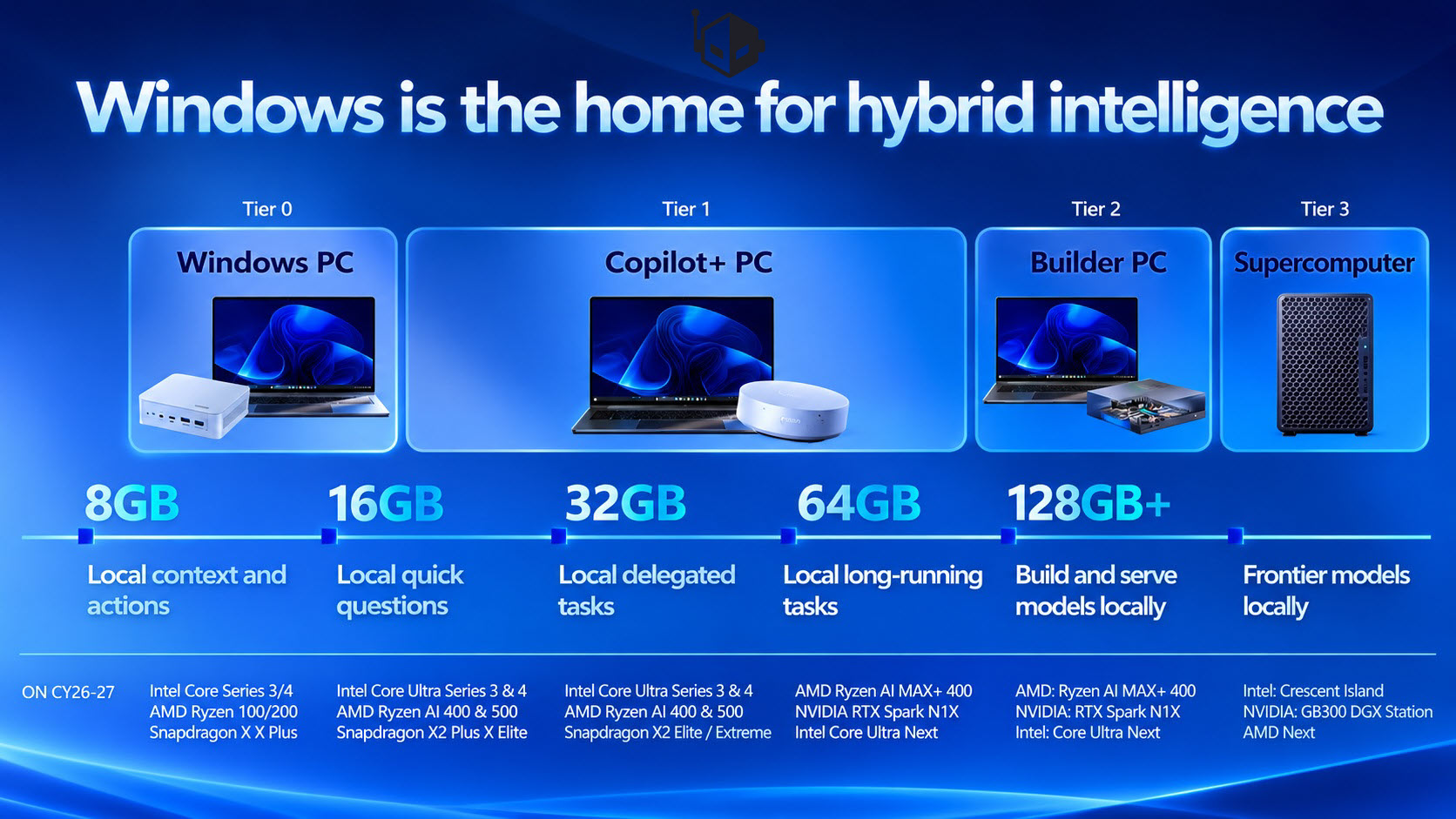
Microsoft says that "Windows is the home for hybrid intelligence", with a device designed for all types of users. The company has laid out four tiers within its AI roadmap, each reflecting the AI capabilities, hardware specs, and market that the product is designed for.
Microsoft Windows "Tier-0" AI PCs
At the entry-level, Microsoft has its "Tier 0" Windows PCs, which start with 8 GB of memory. These PCs are capable of handling local context and actions, essentially, the most basic AI tasks that one user could ask for. The 8 GB memory in itself isn't very usable for even modern-day tasks, & might end up being a bottleneck in many systems unless all you're doing is opening a few browser tabs, accessing email, office files, and using video conferencing/call apps such as Microsoft Teams.
At the entry-level, Microsoft has its "Tier 0" Windows PCs, which start with 8 GB of memory. These PCs are capable of handling local context and actions, essentially, the most basic AI tasks that one user could ask for. The 8 GB memory in itself isn't very usable for even modern-day tasks, & might end up being a bottleneck in many systems unless all you're doing is opening a few browser tabs, accessing email, office files, and using video conferencing/call apps such as Microsoft Teams.

These devices will be built using Intel Core Series 3 "Wildcat Lake", Intel Core Series 4 "Wildcat Lake Refresh", AMD Ryzen 100/200 series, and Snapdragon C, Snapdragon X, and Snapdragon X Plus SoCs. Most of these devices are already available on the market at prices around the $500 US range.
Microsoft Windows "Tier-1" AI PCs
The next category for Microsoft's Windows AI PC portfolio lands in "Tier 1," and this covers the majority of the mainstream segment. These devices start at 16 GB and go all the way up to 64 GBs of memory. The Tier 1 devices are Copilot+ compliant and feature extended AI capabilities such as the ability to tackle local questions, local delegated tasks, and local long-running tasks. Essentially, Tier 1 devices take the majority of your cloud work and do it locally.

For this category, Microsoft starts with Intel Core Ultra Series 3 "Panther Lake", AMD Ryzen AI 400 "Gorgon Point", Snapdragon X2 Plus / X2 Elite, and then also mentions next-gen SoCs such as Intel Core Ultra Series 4 "Nova Lake" and AMD Ryzen AI 500 "Medusa Point". On the premium side, the hardware moves to AMD Ryzen AI MAX+ 400 "Gorgon Halo", NVIDIA RTX Spark "N1X" & Intel Core Ultra Next (which might be referring to a next-gen part that comes after Nova Lake).
Microsoft Windows "Tier-2 & Tier-3" AI PCs
The next two categories are designed for professionals, builders, & workstation-oriented setups. These land in Tier 2 and Tier 3. Tier 2 devices are equipped with 128 GB+ memory, with the ability to build and serve models locally. Microsoft outlines AMD Ryzen AI MAX+ 400 & NVIDIA RTX Spark as the go-to devices available today, with Intel Core Ultra Next and Snapdragon Next outlined as future offerings.
Tier 3 is essentially the workstation platform aimed at tackling frontier models locally. These are large AI boxes, often regarded as personal supercomputers, and are built with server-grade chips such as Intel's upcoming Crescent Island GPUs, which scale from 160 GB per GPU to up to 512 GB per GPU, NVIDIA's GB300 in the DGX Station, and AMD's Next solution such as the Threadripper Halo Station.

All of this goes on to tell that Microsoft is looking way ahead with its Windows AI ecosystem that will be an essential part of its strategy in the years to come, as many devices pack better and better local AI capabilities within them.
Microsoft’s four-tier Windows AI roadmap shows a clear long-term bet: making hybrid intelligence practical and scalable for everyone, from everyday users to professionals running frontier models locally. By aligning hardware, memory, and AI capabilities this way, Windows is positioned to remain the central platform as on-device intelligence becomes a core part of modern computing.
News Source: HXL (@9550pro)