










 05-15-2026, 18:24


 I Am Watching You!





TON´s agentic wallets turn Telegram bots into spending entities

TON’s new Agentic Wallets standard lets Telegram AI bots hold user‑funded wallets on TON, spending within tight limits as semi‑autonomous financial actors inside chat.
Summary
TON Tech has launched “Agentic Wallets,” an open, self‑custodial standard that lets AI agents on Telegram hold funds and execute on‑chain transactions on the TON blockchain without per‑action user approval.
Each agent gets a dedicated wallet funded and owned by the user, with hard spending limits and revocable access, effectively turning bots into bounded financial actors that can trade, pay subscriptions, and interact with DeFi inside Telegram’s roughly 1 billion‑user ecosystem.
The move is being pitched by TON Tech’s Andrew Grekov as the shift from “assistants to actors,” but it also opens a new attack and governance surface around agent misbehavior, prompt‑injection, and blurred liability between users, developers, Telegram, and the TON network.
TON Tech — the infrastructure team behind The Open Network — rolled out Agentic Wallets on April 28, 2026, describing them as “self‑custody wallets designed for autonomous AI agents on TON” that finally give Telegram bots a native way to move money. According to TON’s docs and supporting announcements, each AI agent can spin up its own on‑chain wallet, funded directly by the user; the agent then manages that balance autonomously, while ownership remains anchored to the user’s main wallet and can be revoked at any time.
TON’s AI agents get real wallets, not just UX gloss
Crucially, this is not a custodial layer or a centralized key‑escrow hack. TON Tech stresses that “no intermediary holds funds at any point” and that existing TON wallets require “no upgrades” to plug into the scheme, which is implemented as a standard contract pattern rather than a new app silo. The design uses a split‑control architecture: users keep the master keys; agents get narrow, contract‑level permissions to initiate transfers, swaps, and DeFi interactions within a predefined budget, with the ability for users to pull funds or kill the agent’s access at will.
From a product perspective, the key move is that Telegram itself becomes the UI and distribution layer. Telegram’s bot infrastructure and bot‑to‑bot messaging already run across a reported 1 billion‑plus users; Agentic Wallets plug into that fabric so that a user can literally ask a bot in chat to “create a wallet,” fund it, and then let it pay for services, exchange tokens, or execute transactions from inside the same interface. As Grekov puts it, “Agentic Wallets turn AI agents from assistants into actors — agents on Telegram can not only communicate, but transact,” collapsing the distance between conversation and settlement into a single app.
Programmable capital with a will — and a bigger attack surface
The concrete use cases TON Tech and third‑party write‑ups are pushing are exactly the ones you’d expect: trading bots with predefined budgets, DeFi agents that handle staking and portfolio rotations, and automation for subscription payments, API usage and micro‑transactions, all without routing through custodians. Blockster’s analysis is blunt: this “pushes Telegram‑based AI agents beyond simple assistants and into something closer to autonomous financial actors,” meaning that once budgets and rules are set, the agent can hold balances, make payments, and interact with on‑chain applications without a human clicking “confirm” on every transaction.
For crypto, that is the actual “AI + blockchain” crossover that matters: not vaporous “AI tokens,” but agent frameworks that can maintain positions, roll perps funding, dollar‑cost average into a basket, or run a Polymarket/Kalshi‑style prediction‑market book 24/7 inside a chat app. In practice, it means your next trading strategy, recurring remittance flow, or cross‑border bill‑pay could be delegated to scripts with persistent identity and direct on‑chain reach, turning capital into something closer to a semi‑autonomous process than a pile of passive balances.
The flip side is that the governance and security surface just exploded. None of the launch materials resolve what happens when an “agent” griefs a protocol, front‑runs retail flow, or becomes part of a cartel coordinating MEV‑style behavior across DeFi inside Telegram. The attack vectors are obvious: prompt‑injection or jailbreaks that subvert an agent’s policy layer, Telegram account takeovers that let an attacker reconfigure or drain agent wallets, or poorly written agent logic that autocompounds bad positions and nukes user balances while formally staying “within budget.”
Legally and politically, the liability chain is completely undefined: when an agent running in Telegram uses an Agentic Wallet to launder funds or exploit a DeFi contract, the blame can be projected onto the user, the bot developer, TON Tech’s standard, or Telegram’s distribution layer, with no clear doctrine yet to apportion responsibility. That ambiguity is exactly why this launch is bigger than another “AI wallet” gimmick — it’s the first serious attempt to normalize autonomous agents as on‑chain actors inside a mainstream consumer app, with all the upside and all the systemic risk that implies.
Toncoin price at key $2 support, can an impending golden cross trigger a rebound?

Toncoin price continued consolidating near a critical support region this week after a sharp post-breakout correction, while technical indicators suggested a potential longer-term trend reversal could still be developing.
Summary
Toncoin price continued consolidating near the key $2 support zone after retreating from its recent rally toward the $2.90 region.
TON formed a potential bullish flag pattern on the daily chart while the 50-day and 200-day moving averages approached a possible golden cross.
A breakout above the descending channel near $2.30 could open the door toward $2.90–$3, while losing $2 support may expose TON to a pullback toward $1.80.
According to data from crypto.news, Toncoin Toncoin
TON
-6.66%
Toncoin price traded around $2.01 at press time on May 15 after briefly falling below the key psychological $2 support level earlier in the session. Despite the recent pullback, the token remains significantly above its April lows near the $1.20 region.
Toncoin’s earlier rally was fueled by renewed optimism surrounding the TON ecosystem and improving sentiment across Telegram-linked crypto applications. Traders also continued monitoring speculation surrounding deeper blockchain integrations within Telegram’s broader ecosystem, which helped drive strong buying momentum earlier this month.
However, the latest correction suggests that short-term bullish momentum has cooled after TON surged nearly 100% in just a few sessions. The token faced heavy resistance near the $2.80–$2.90 region, triggering profit-taking activity and a gradual decline over the past several days.
At the same time, participation across the TON ecosystem remains below peak levels seen during last year’s rally cycle. Decentralized finance activity and transaction growth have stabilized but have yet to fully recover, while several TON-linked gaming and tap-to-earn projects continue trading far below their previous highs.
Toncoin price analysis
On the daily chart, Toncoin appears to be consolidating inside a downward-sloping channel following its explosive breakout rally earlier this month. The structure resembles a potential bullish flag pattern, which typically forms after a strong impulsive move higher and often signals temporary consolidation before trend continuation.
On the daily chart, Toncoin appears to be consolidating inside a downward-sloping channel following its explosive breakout rally earlier this month. The structure resembles a potential bullish flag pattern, which typically forms after a strong impulsive move higher and often signals temporary consolidation before trend continuation.
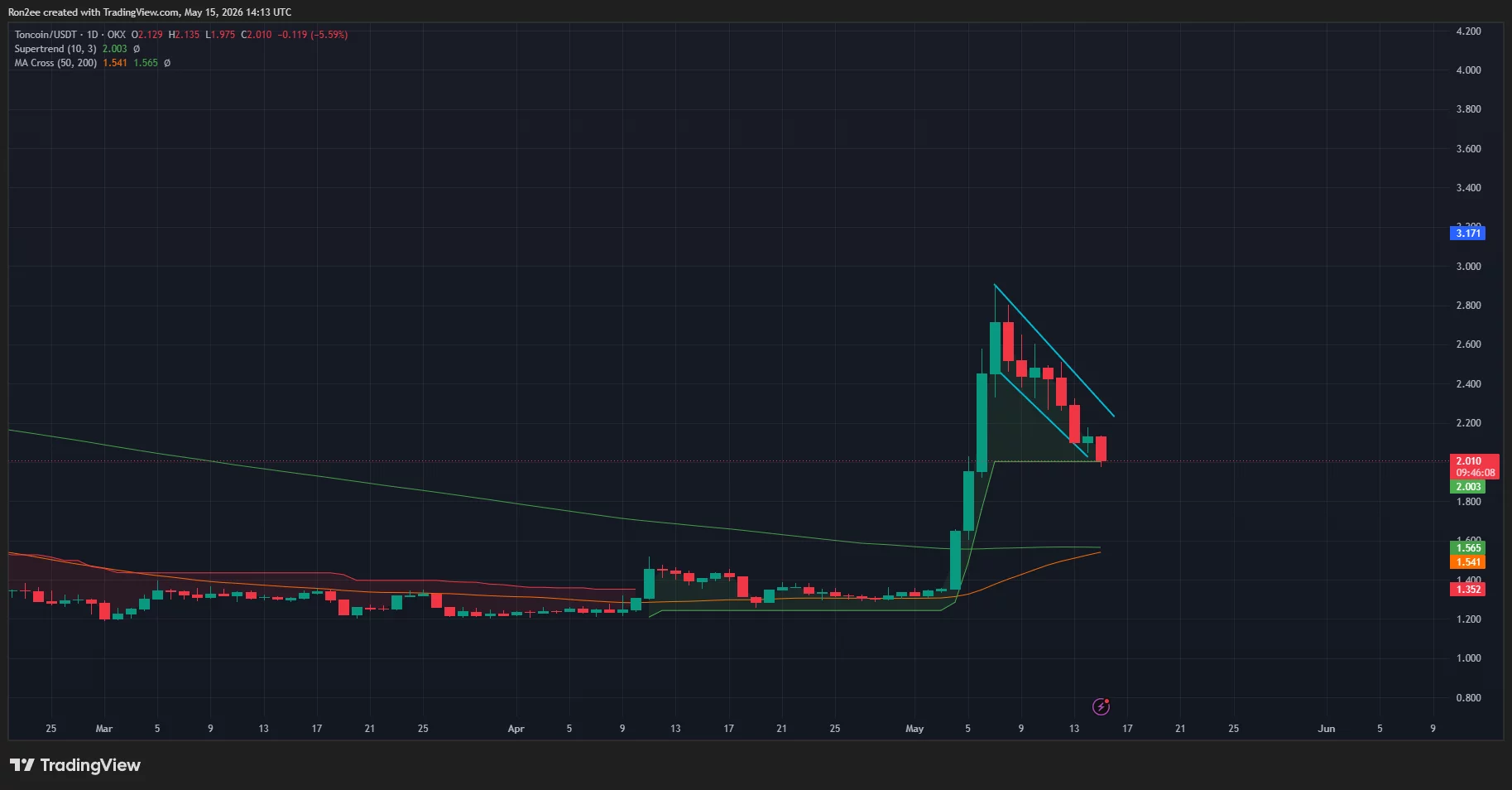
TON continues defending the important $2 support zone, which also aligns closely with the daily Supertrend support visible on the chart. Holding above this level could help preserve the broader bullish structure despite the ongoing cooldown phase.
One of the more important technical developments is the approaching golden cross formation between the 50-day and 200-day moving averages. A golden cross occurs when the shorter-term moving average crosses above the longer-term moving average and is generally viewed as a bullish long-term trend reversal signal.
The 50-day moving average has now started curving sharply higher toward the 200-day moving average following TON’s recent breakout rally, suggesting bullish momentum may gradually be strengthening despite the current consolidation.
Momentum indicators, however, continue showing mixed signals in the short term. The MACD histogram has weakened noticeably over the past several sessions, while the MACD lines are attempting to stabilize after approaching a bearish crossover earlier this week.
If bulls successfully reclaim the upper boundary of the descending channel near the $2.25–$2.30 region, Toncoin could attempt another move toward the recent swing high near $2.90. A confirmed breakout above that resistance zone may then open the door toward the psychological $3 level.
On the downside, failure to hold above the key $2 support region could weaken the bullish continuation structure and potentially expose TON to a deeper retracement toward the $1.80 area, where buyers previously stepped in during the initial breakout phase.

GOOGLE HANGOUTS ( Email ): theseller.ti@gmail.com
Discord: theseller.ti
TI.com Telegram: t.me/T0rrentinvites
Telegram: @T0rrentinvites
GOOGLE HANGOUTS ( Email ) Purchase of a tracker: t0rrentinvites.com@gmail.com


 Return to Top