










 10-24-2026, 21:08

 Senior Member




AMD Zen 6 Shows Up To 24% Higher Per-Clock Performance Than Zen 5, Promising A Big Leap For Ryzen Upgraders

AMD's Zen 6 core architecture has been tested in Geekbench, showcasing strong single-core performance versus Zen 5, which is great news for those waiting for next-gen Ryzen CPUs.
AMD 4 GHz "Zen 6" CPU Comes Close To A 5.5 GHz "Zen 5" CPU, And That Means Next-Gen Ryzen Chips Can Offer A Fantastic Leap In Performance
The AMD EPYC 9006 "Venice" CPU lineup launched a few months back and has been shipping in volume since. As the company ramps up production, the first benchmarks of EPYC CPUs are now landing within the Geekbench database.
RELATED STORY AMD’s 12-Core Ryzen CPU With A Single 12-Core “Zen 6” CCD Could Match The Ryzen 9 9950X3D2 “Zen 5” Chip In Multi-Threaded Performance, Says Hydra Tool Creator
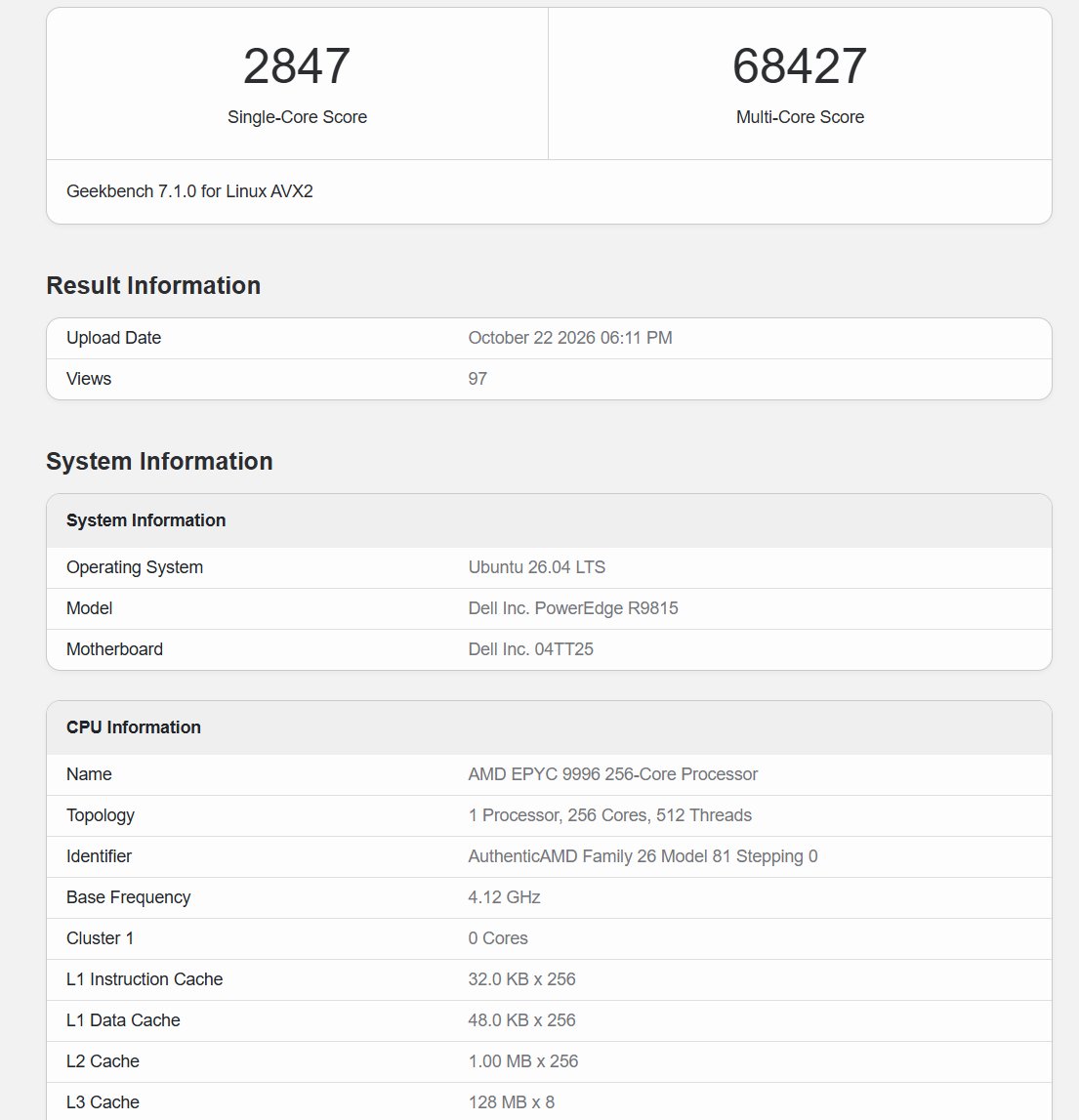
The flagship AMD EPYC 9996 CPU, a 256-core and 512-thread SKU, has appeared with a single-core score of 2847 points and a multi-core score of 68,427 points. While the single-core results may not sound that good, it should be noted that the chip was operating at a frequency of 4.12 GHz, which also happens to be its maximum boost frequency. The chip features a mammoth 1.0 GB of L3 cache and 256 MB of L2 cache. It also has a rated TDP of 600W which can be configured down to 400W.
Zen Architecture(s) Zen 6 (Ryzen) Zen 3 - Zen 5 (Ryzen) Zen 1 - Zen 2 (Ryzen)
Max CCDs 2 2 1
Max IODs 1 1 0
Max Cores per CCD 12 8 4
Max Cores per Chip 24 16 8
Max L3 per CCD 48 MB 32 MB 32 MB (16 per CCX)
Max L3 per Chip 96 MB 64 MB 32 MB
Max CCDs 2 2 1
Max IODs 1 1 0
Max Cores per CCD 12 8 4
Max Cores per Chip 24 16 8
Max L3 per CCD 48 MB 32 MB 32 MB (16 per CCX)
Max L3 per Chip 96 MB 64 MB 32 MB
Now why this result is so interesting is because of the fact that we can compare it directly against faster "Zen 5" chips. An AMD EPYC 4545P 16-core chip offers a boost clock of up to 5.5 GHz, and scores 3064 points in the single-core tests.
If we do the math's, the per-clock performance of the AMD Zen 6 chip is up to 24% higher than the Zen 5 chip.
If we do the math's, the per-clock performance of the AMD Zen 6 chip is up to 24% higher than the Zen 5 chip.
One user even compared his Ryzen 7 9700X at a fixed clock of 4.1 GHz using DDR5-6000 (CL34) memory. The results once again showcase up to a 24-25% higher performance and an average uplift of 16.5% which means that at the same clock speeds, Zen 6 will be mighty impressive.
We also have to consider the fact that the EPYC 9006 chip is based on Zen 6C cores and while the ISA is the same, Zen 6C is denser and more efficient than standard Zen 6 cores, plus with optimized memory support on enthusiast desktop platforms, Zen 6 will be able to deliver an even greater punch.
As per previous rumors, AMD is expected to boost the clock speeds on its Zen 6 chips. In our preview of the Ryzen "Zen 6" lineup, we mentioned that AMD has upped the clock rates and the power on its EPYC chips.
A similar tuning for desktops will be nice, but we expect the final figure on the Olympic Ridge family to be even higher. Couple that with higher core counts, more 3D V-Cache, and a overhauled architecture, AMD's next-gen Ryzen CPUs will be able to offer a superb leap over Zen 5 and that too on the same AM5 socket.
AMD Olympic Ridge vs Intel Nova Lake-S:
CPUS INTEL CORE ULTRA 400 AMD RYZEN 10000?
Family Nova Lake-S Olympic Ridge
Architecture Coyote Cove (P-Core)
Arctic Wolf (E/LP Core) Zen 6
CPU Process TSMC N2P TSMC N2P
Core Count (Max) 52 24
Thread Count (Max) 52 48
Max P-Cores 16 24
Max E-Cores 32 N/A
Max LP-E Cores 4 N/A
Max Cache (L2+L3) 160-320 MB 96 MB L3
Max 3D/bLLC Cache 144-288 MB 144-288 MB
DDR5 (1DPC 1R) 8000 MT/s
CUDIMM - Yes 7200 MT/s?
CUDIMM - Yes
PCIe 5.0 Lanes (Max) 36 TBD
PCIe 4.0 Lanes (Max) 16 TBD
Socket Support LGA 1954 AM5
Max TDP (PL1) 125-175W 125W+
Max Power ~700W (Dual)
~350W (Single) TBD
Launch 2027 2027

 Return to Top